Check mark on list, Check list in business

From Bottlenecks to Breaking Ground: Why COP30 Must Prioritize Early-Stage Project Preparation
How catalytic finance and smart project preparation can turn ambitious climate and development goals into investable pipelines.
Emerging Markets and Developing Economies (EMDEs) are rich in climate ambition, yet face a debilitating paradox: they have plenty of early-stage project concepts, but insufficient early-stage finance and, in many cases, limited technical capacity to transition from concept to reality.
Every year at COP and other international venues, financiers and investors underscore a persistent struggle to find well-prepared, “bankable” projects that match their risk appetite and investment criteria. Yet the true challenge often lies in chronic underinvestment at the critical early stages of project preparation, when concepts are validated, feasibility assessed, and investor readiness established.
Only by prioritizing early-stage project finance and technical support can COP30 effectively turn global climate commitments and country ambitions into tangible outcomes and accelerate the delivery of the New Collective Quantified Goal (NCQG).
Mapping the future of project preparation
So why are finance-ready projects in some EMDEs still so rare? And what will it take to scale the next generation of PPFs and technical tools to unlock the projects that EMDEs are ready to lead?
RMI and the NDC Partnership (NDCP) have spent the last six months digging into that question. We surveyed over 20 PPFs, interviewed public and private investors, and stress‑tested our findings at the Global NDC Conference in Berlin. Below are our takeaways — and how COP30’s “Action Agenda” and a focus on early-stage project finance in NCQG implementation, including as part of the roadmap to the $1.3 trillion, can aid the transition from ideation and pilots to a robust pipeline of bankable and high-impact climate projects in EMDEs.
Bridging the climate finance gap
Under the NCQG on climate finance agreed at COP29, Parties set a floor of at least $300 billion per year by 2035 — with developed countries taking the lead — and called on all actors to work together to enable scaling up external finance for developing countries to at least $1.3 trillion per year by 2035 from public and private sources.
Yet even this level would fall short of actual requirements. The Independent High-Level Expert Group (IHLEG) estimates total investment needs for EMDE (excluding China) could be as high as $2.4 trillion annually by 2030 to support a comprehensive range of climate and nature-related needs. This gap is also underscored by developing countries’ own estimates in their Nationally Determined Contributions (NDCs), which collectively quantify far higher financing needs than current flows or commitments.
To help chart a pathway toward these targets, the international community launched the Baku to Belém Roadmap to outline the tools, strategies, and financing mechanisms needed to achieve the NCQG.
Yet even with a roadmap, progress is stalled by stubborn macroeconomic barriers—liquidity constraints, limited local currency financing, technical capacity gaps, and high capital costs—compounded by weaknesses in countries’ absorptive capacity.
Addressing these challenges typically requires blended and catalytic finance to better align project risks with investor expectations, alongside longer-term financial sector strengthening and supportive regulatory measures. However, the most immediate and actionable lever — early-stage project preparation — remains chronically underfunded and fragmented. Without stronger and more coordinated project preparation support, even well-designed financing solutions struggle to gain traction.
Why early-stage project finance matters
Climate projects typically pass through six stages: concept, feasibility, development, financing, construction, and operation [See graphic below]. According to recent assessments, roughly 70 percent of projects in EMDEs never move beyond the feasibility stage — and this rate is even higher in Africa. Key reasons include inadequate funding for technical assessments, studies, and data sourcing; unclear or unattractive risk-return profiles; and insufficient local institutional support or capacity during critical early-stage development.
There is high and diverse demand for project preparation support: to date, the NDC Partnership has received more than 1,200 requests from nearly 80 countries for assistance in developing bankable projects and pipelines (~50 percent of these requests have been supported thus far). Those that do advance often struggle to secure necessary catalytic and later-stage commercial financing due to risk perceptions and institutional bottlenecks.
The bottlenecks
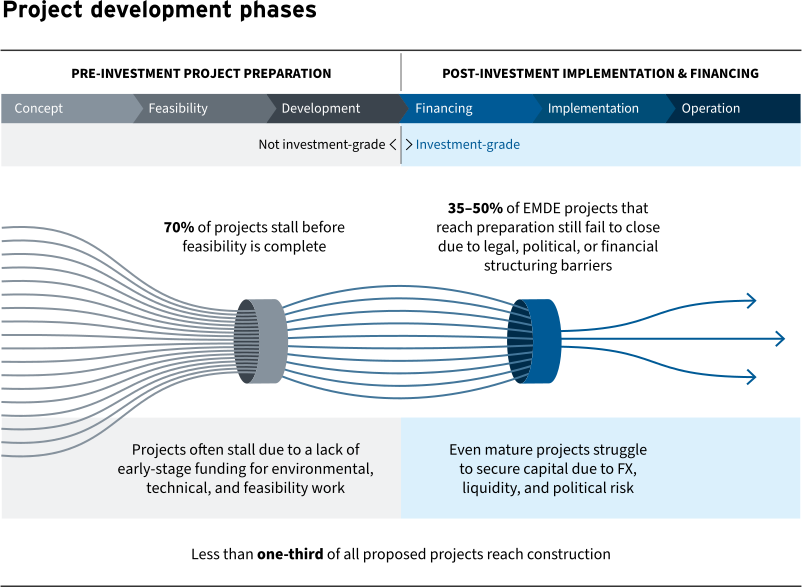
Without targeted interventions at the earliest stages of project development, promising climate infrastructure initiatives in EMDEs remain stalled — undermining national climate ambitions and delaying progress toward the implementation of the NCQG. Project preparation support through PPFs, along with embedded technical assistance and capacity-building support, is critical for advancing these early phases by providing feasibility analysis, risk structuring, and policy alignment. However, persistent information gaps between investors, governments, and project preparation support contribute to a fragmented and underfunded ecosystem.
Key bottlenecks holding back EMDE project preparation
Our insights into the global project preparation support ecosystem — specifically focused on PPFs — revealed persistent structural obstacles to their success, alongside valuable lessons from experienced practitioners and institutional stakeholders. While acknowledging the broader ecosystem of project preparation support, our research and interviews concentrated on the experiences and perspectives of PPF practitioners, experts, and funders. The barriers most consistently raised by these stakeholders fall into three categories: (1) foundational and structural challenges, (2) institutional and operational gaps, and (3) systemic market-level biases. The following sections explore these challenges — and the promising practices emerging in response.
Systemic challenges in today’s project preparation support landscape
Fragmentation and complexity: Project developers must navigate a fragmented and complex landscape of PPFs, each with distinct procedures and criteria, which can result in delays, wasted resources, and increased transaction costs. This mirrors the broader fragmentation and complexity of the international climate finance architecture, underscoring a systemic challenge.
As highlighted by coalitions like the Cities Climate Finance Leadership Alliance (CCFLA), there is an urgent need for unified, nationally led platforms to better coordinate development partners and MDB engagement.
Overdependence on grants and donor funding: Most PPFs remain heavily reliant on short-term donor grants and funding cycles, severely limiting their scalability and financial sustainability. Furthermore, replenishment cycles and fundraising divert critical staff and financial resources away from core project preparation activities, exacerbating existing capacity constraints due to often limited staffing. This dependency has become increasingly risky amid global reductions and growing uncertainty in international aid budgets.
Underused catalytic finance instruments: Furthermore, relying on grants as the primary means of disbursing payments for PPF activities, which are essentially 100 percent concessional, limits the impact of limited financial resources, which could be significantly amplified using more sustainable and targeted catalytic instruments.
Despite these constraints, many PPFs remain disconnected from financing tools such as returnable grants, convertible instruments, working capital loans, blended concessional finance, seed funding, and early-stage equity, all of which can enhance their ability to mobilize investment and recycle capital to support new projects over time. This underutilization often stems from restrictive mandates, limited connections to investors and philanthropic networks, and institutional preferences for later-stage, lower-risk financing structures.
As a result, some PPFs only finance select studies to meet investor requirements, such as environmental and social safeguards, gender action plans, stakeholder consultations, or technical assessments, without providing the broader financial or strategic support needed to develop a fully investable project.
How institutions, capacity, and market biases hold project preparation back
Capacity and technical gaps: Constrained by short timelines and funding structures, PPFs often must rely on fly-in-fly-out consultants and fragmented engagements, resulting in shallow local involvement, weak knowledge transfer, and minimal follow-up. Many also face limited local staffing, rigid mandates, and a lack of sustained support—all of which hinder their ability to develop strong, investor-ready projects.
This also represents a missed opportunity to improve enabling environments by expanding access to localized climate and market data, enhancing institutional learning and absorptive capacity, and providing the iterative support necessary for refining feasibility studies, strengthening financial models, and building country-led ownership.
Ultimately, the absence of embedded, context-aware support undermines country readiness, limits alignment with evolving policy frameworks, and reduces the long-term bankability and scalability of projects.
Misalignment with national priorities and frameworks: Often due to limited capacity and technical gaps, PPF practitioners repeatedly emphasized insufficient alignment between PPF activities and country-driven planning processes, including Nationally Determined Contributions (NDCs), National Adaptation Plans (NAPs), and related national efforts strategies. Without integration into national priorities and planning cycles, PPF initiatives risk becoming isolated, duplicative, or redundant.
Limited local institutional capacity underscores the need for tailored, integrated and agile collaboration, sustained country engagement, and alignment with domestic policy frameworks to foster ownership, coherence, and effective project implementation.
Structural bias toward big projects in big markets: PPFs tend to prioritize larger, more mature projects in more liquid capital markets, overlooking important smaller-scale projects, such as community-led or nature-based solutions, due to perceived or actual high transaction costs, risk, and complexity. For instance, regional and international PPFs operating in Africa typically concentrate their investments in South Africa, Kenya, and Egypt, while joint Latin America and Caribbean funds primarily direct financing toward Latin American countries, leaving Caribbean nations underserved and projects in these areas underfunded.
From bottlenecks to breakthrough
Building on lessons learned and best practices from existing PPFs, the international community now has an opportunity to develop a unified and updated coordination framework for project preparation informed by real-world insights from today’s PPF ecosystem. The preliminary recommendations below, drawn consistently from literature and our interviews, highlight systemic best practices essential for scaling early-stage project finance. While these solutions do not directly map onto each of the bottlenecks outlined earlier, they consistently emerged across literature and interviews as high-impact actions.
Furthermore, COP30 and the presentation of the Baku to Belém Roadmap to $1.3T offer an unparalleled opportunity to address these bottlenecks directly through strategic policy commitments, funding pledges, and global action outlined in its Action Agenda.
Key recommended actions include:
Embedded technical assistance and local capacity building: Effective PPFs embed technical advisors directly within local institutions and project teams, thereby enhancing long-term institutional capabilities, facilitating knowledge transfer, and increasing the capacity for ongoing project implementation. This model also helps grow the pool of local expertise and strengthen developer ecosystems, fostering more sustainable and self-reliant project development environments over time. This practice has been notably successful in municipal-level facilities and city-focused development banks.
Early investor engagement: PPFs that proactively involve investors early through workshops and stakeholder dialogues experience greater success. Early involvement ensures projects align with investor expectations, accelerating progress toward finance-ready project designs and investment mobilization.
Standardization of project documentation and processes: Several PPFs have successfully adopted standardized templates for key processes, such as pre-feasibility studies, financial modelling, and environmental and social assessments — significantly reducing duplication, lowering transaction costs, and accelerating overall project readiness. Where possible, efforts should also aim to promote greater standardization and synchronicity across PPFs, making it easier for developers to navigate requirements and for investors to assess projects consistently. These improvements are most effective when paired with training and capacity building on the use of standardized documents, ensuring high-quality application and broader uptake.
Aggregation of smaller projects: Numerous PPF practitioners emphasized the importance of aggregating smaller-scale projects into larger portfolios whenever possible, which can often lower transaction costs, improve project and portfolio economics, and reduce the need for individual project preparation activities. Aggregation can also enhance investment appeal by improving overall project bankability. In regions such as the Caribbean and Pacific Islands, aggregation through bulk procurement strategies has proven especially valuable — helping small island nations achieve economies of scale, streamline vendor engagement, and attract investor interest.
Country-led climate finance and matchmaking platforms: National ownership through country-led platforms ensures project pipelines align closely with climate and development strategies, enhancing coherence, efficiency, and effectiveness. Given the declining prospects for ODA and grant funding, such coordination is essential for achieving institutional buy-in and ensuring long-term project readiness. Stakeholders also emphasized the need to streamline interactions between project proponents, PPFs, and financiers through national or regional matchmaking platforms, aiming to reduce fragmentation, improve data alignment, and enhance visibility of available support. Promising examples include South Africa’s Presidential Climate Commission, which is leading the Just Energy Transition Investment Plan, and Colombia’s Climate Finance Broker Facility, which can directly connect national climate priorities to financing.
Scale up early-stage financial instruments: The international community can increase funding availability using underutilized, innovative financial instruments. Effective PPFs leverage underutilized catalytic financial tools such as revolving funds, returnable grants, early-stage blended finance structures, and risk mitigation instruments. These tools enable more flexible and sustainable project preparation, allowing funds to be recycled and risk distributed more evenly. Impact-linked financing instruments also represent a promising opportunity, particularly for impact investors and philanthropy, by tying funding to measurable outcomes and ensuring that concessional resources drive greater effectiveness and accountability. Aligning PPFs with concessional capital explicitly treated as catalytic—not merely soft—can significantly improve the bankability of early-stage projects. Scaling their use will be essential to unlock private investment and build robust, investable pipelines aligned with NCQG targets.
The COP30 imperative: turning finance into impact
Brazil’s COP30 Presidency has emphasized collective action (mutirão) to accelerate implementation and investment through activation groups bringing together public, private, and non-state actors and is leading the work on the Baku to Belém Roadmap to enable scaling up to $1.3 trillion per year of climate investment in developing countries by 2035. Central to this agenda must be the acceleration of project cycles by strengthening of project preparation and de-risking offerings and prioritizing early-stage finance, directly addressing the critical bottlenecks highlighted.
Without decisive action at COP30 to tackle the “disenablers” and to scale up climate finance, clearly outlined in the NCQG decision, local and international climate and development targets risk remaining only aspirations rather than actual achievements.
Dedicated early-stage funding through robust, streamlined, and effectively resourced PPFs can make a significant and timely difference in the implementation of the new Nationally Determined Contributions (NDCs). When empowered to operate strategically and at scale, PPFs can substantially de-risk projects, build strong risk-return profiles, build local lasting capacity and ownership, and generate pipelines of investable opportunities.
COP30 must translate ambition into tangible action by addressing the current weak link in climate finance and strategically empowering project preparation in emerging and developing markets, and investing in early-stage project finance. Only through bold and collaborative efforts can we bridge the gap between project concept and impact, enabling emerging markets and developing economies to lead a successful and just transition.
The authors wish to thank Daniel Gunton, Maxwell Hyman, and colleagues from the NDC Partnership for their contributions to this article.